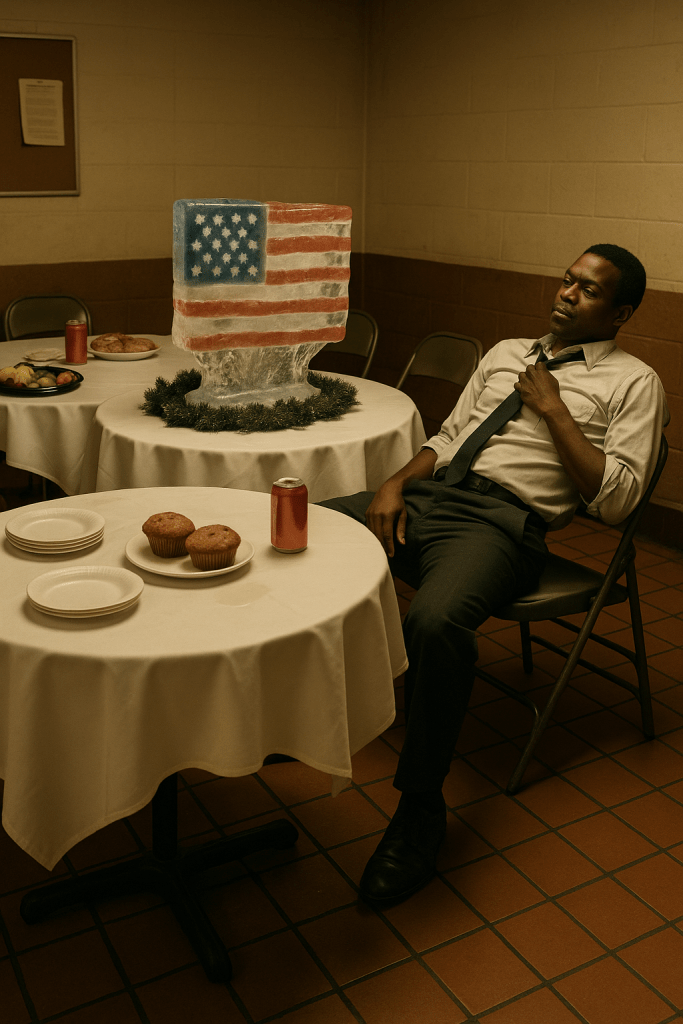
Frank Wills loosened his tie as he leaned back in the metal folding chair. He was the only one in “the green room”, which was actually the employee break room for the hotel’s kitchen staff. Three round tables stood in a row in the middle of the room, with white table cloths in sharp contrast to the dingy tan walls and brick tile floor. The tables held an assortment of paper plates, fruit trays, muffins, sodas, and napkins. A large ice sculpture of the American flag was centered on the middle table, ringed with green garland likely swiped from the hotel’s Christmas decor. Frank slouched in the chair and stared blankly at the water dripping off of the bottom corner of the flag, making a puddle on the table below.
He heard the voices coming from the portable Sony radio on one of the tables, but he didn’t listen to what was being said. There was no need, he had heard it all before. G. Gordon Liddy of Watergate fame had started a radio show on Washington, DC’s WJFK 106.7 FM earlier that year. Today’s live broadcast of Liddy’s show from the ballroom of the Watergate Hotel marked the 20th anniversary of the famous break-in.
When the show’s producers called several weeks before to ask if Frank would be willing to take part in the event, he had agreed on two conditions: the station pay for his airfare, and pay for his hotel room. He didn’t have the money for either. WJFK held up their end of the bargain, but as was the case for most of the last twenty years, that was as far as the red carpet had been rolled out.
It was Frank’s first time back to the Watergate since he had quit his job there as a security guard after the scandal became public. He hadn’t expected a medal or statue in his honor, but Frank did feel he was entitled to a promotion. As he saw it, how often could a company claim that one of their employees had helped foil one of the most famous crimes in the nation’s history? But apparently the company thought otherwise, and Frank quit. His luck hadn’t changed much since.
At first there were media opportunities and interviews regarding his part in the story. How he had noticed the doors left open suspiciously, how he moved from suite to suite with the responding officers, and how he had found the burglars hiding in the Democratic National Committee offices. He had been cast to play himself in the 1976 movie All The President’s Men. He even worked briefly as a spokesperson for a line of dietary supplements marketed by the comedian Dick Gregory. But the phone stopped ringing. With only an 11th grade education and no real job prospects, he moved back to South Carolina to care for his ailing mother. In the years that followed, Frank smoldered with resentment as the Watergate ringleaders gave talks, wrote books, and capitalized on their crimes. Meanwhile, he and his mother barely survived off of her monthly Social Security checks. Things got so bad that he had been arrested for shoplifting and spent time in jail.
So when the producers called, Frank thought that maybe this would be the moment that his fortune would change. Now he would make a name for himself and be recognized for the integral part he had played in history, instead of remaining a footnote.
As he walked through the lobby of the hotel, Frank tried to find some of the long forgotten confidence of his youth. But he couldn’t help to notice how much his scuffed wing-tips and threadbare suit differed from those passing him now. And while he still remembered the route through the hotel’s corridors as if he had patrolled them yesterday, it felt more like a lifetime instead of twenty years since he had been that young man. The world and luck had simply passed him by. As it passed, those whom he had caught trying to cheat it back then somehow came out clean and prosperous here on the other side. Meanwhile, Frank felt like he had been barely treading water for years, and the resentment he felt hung on his ankles like bricks making it harder to stay afloat by the day.
When he entered the makeshift green room, Frank was surprised to find he was the only person there other than a small man with glasses and thinning hair. He checked his watch and wondered if he was late as the man introduced himself as one of the show’s producers.
“Mr. Wills, I’m afraid I’ve got some bad news,” the man said, brushing crumbs off the nearest table. “It looks like we’ve overbooked on guests, and Mr. Liddy doesn’t think we’ll have enough time to fit you in the show today. I’m terribly sorry for the mix up, but you’re welcome to stay, have some refreshments, and listen to the show on the radio in here! Maybe we can try to get you on the show sometime in the future.”
The producer turned and left the room before Frank could say a word. For several moments he stood motionless, jaw clenched, glaring at the break room door.
Now, sitting in the folding chair, Frank kept staring at the frozen flag on the table. He thought about his life since that famous night twenty years ago, and realized that all he wished for and all that the frozen flag represented were one and the same. Hope, glory, opportunity, slowly melting away into nothing.
Finally, Frank shook his head, got up from the chair, and took a soda from the table. He stood before the sculpture for a moment, then placed his hand to the ice and pushed. As he walked out of the room, Frank heard G. Gordon Liddy’s voice over the radio mixed with the sound of crushed ice sliding across the tiles.
 Larry Brown's Ghost
Leave a comment